consent_cookie
Duración: 1 year
Stores the user's cookie consent state
21-10-2026
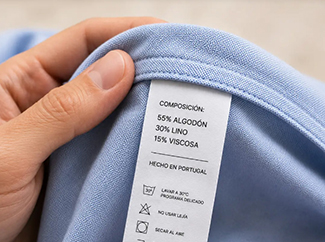
Despite the widespread belief that most people cut off the label after buying a garment, a study carried out by Humana reveals that 61.6 per cent of second-hand clothing arriving at its sorting centres retains its label intact and perfectly legible, whilst 38.4 per cent either has a damaged or worn label, making it impossible to determine the garment’s composition.
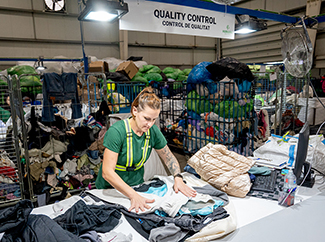
Humana analysed 1,000 items in the ‘original clothing’ category – that is, items collected from street-side containers in the provinces of Barcelona and Tarragona, without having undergone any prior sorting process.
Of the 1,000 garments analysed, 61.6 per cent had their labels intact and perfectly legible; in 28.8 per cent of cases, the label had been cut off; and in 9.6 per cent, it was worn away and its contents could not be made out.
“For the textile waste management sector, it is not enough simply to define what information must be provided when a garment is sold. It is also important that this information remains accessible when the garment is used, discarded and placed in a bin, sorted or resold,” says Rafael Mas, Director of Projects and Institutional Relations at Humana.
One of the conclusions of the analysis is that labels are cut off three times more frequently than they wear out, suggesting that the loss of integrity is not solely due to the ageing of the garment, but that there is also deliberate tampering with the labels. The main reason for cutting them off is physical discomfort or a lack of knowledge about the care symbols, according to a study by Ginetex, the International Association for Textile Care Labelling.
Furthermore, the proportion of worn-out labels on children’s clothing is almost double that found on adults’ clothing, which may be because children’s garments are washed more frequently, passed from one child to another and subjected to particularly intensive use.
Extending the life of clothes
“The information must outlast the garment’s first life,” says Rafael Mas, adding: “Textile labels are useful, but their effectiveness as a permanent information system has limitations, which is particularly important in an economy that aims to extend the life of garments in the future.”
“The sector argues that a garment’s useful life should not end when someone discards it and places it in a clothing bank. However, this report finds that 38 per cent of items whose lifespan could be extended have no label or an illegible one. This lack of information is detrimental to the consumer and to what our sector stands for,” says the representative from Humana, “the design of labels, their durability, comfort and potential compatibility with other information systems deserve a review”.
When the composition label is cut off or becomes worn, the garment loses its ‘passport’. In this context, the future implementation of the Digital Product Passport (DPP) – a mandatory digital record that compiles and centralises all information on a garment’s life cycle – takes on greater significance. The DPP for the clothing and textile sector in the European Union (EU) is expected to become mandatory between late 2028 and 2029.
The EU is expected to publish a delegated act on textiles in 2027, relating to its Regulation on the eco-design of sustainable products. This act will set out the requirements of the DPP in detail, for example: what information must be included and who is responsible for it.
The European Commission is proposing a QR code, an NFC tag or an RFID identifier printed on the label or on the garment itself. A digital scan would allow consumers, authorities and businesses to access the information, with real-time verified data on the garment.