consent_cookie
Duración: 1 year
Stores the user's cookie consent state
07-04-2026
With nearly a hundred establishments lining its streets, Madrid is the city with the most second-hand clothing stores in Spain, followed closely by Barcelona. Not only is it the epicenter of the sector in our country, but it also ranks among the top five European capitals for second-hand fashion offerings. These are some of the key findings from a report analyzing this increasingly prestigious sector, prepared for the second consecutive year by Humana.
The study, based on 2025 data, counts 861 physical second-hand clothing stores in Spain after analyzing 250 municipalities with more than 20,000 inhabitants. Madrid and Barcelona position themselves as the core of the sector, with 98 and 91 stores respectively, placing them in the upper tier of European capitals with the highest concentration of these establishments.
The European country with the largest supply of second-hand clothing is the United Kingdom, boasting 10,132 charity shops. Consequently, London is the European and global capital with the most points of sale (872), far outpacing other major cities. The second capital with the most second-hand stores is Paris (226), followed by Rome (150) and Berlin (106).
Madrid, with its nearly 100 physical stores, ranks among the top five, ahead of Vienna (95). Immediately following is Barcelona (91 stores), placing it among the top seven major cities most attractive to consumers of reused fashion.
“After many years in which the second-hand sector faced all kinds of prejudices, the two main Spanish cities can now hold their own against the rest of Europe,” says Rafael Mas, Director of Projects and Institutional Relations at Humana. “Madrid and Barcelona are very close to the supply found in Berlin, for example, allowing us to see ourselves as equals to countries we envied not so long ago.”
Physical stores on public streets
Humana has spearheaded this study for the second year in a row. The first report, using 2024 data, counted 743 physical stores. “We cannot directly compare figures from one year to the next, as we significantly expanded the sample of analyzed municipalities (from 173 to 250) in the most recent document, which distorts any direct comparison,” Mas explains.
According to 2025 data, residents of Madrid enjoy the largest selection: the city is the sector's epicenter with 98 stores, most of which are located in the center, specifically in the Malasaña and La Latina neighborhoods. It is followed by Barcelona with 91 points of sale; vintage and second-hand lovers there typically shop in the Raval and Gràcia districts.
Other notable Spanish cities include:
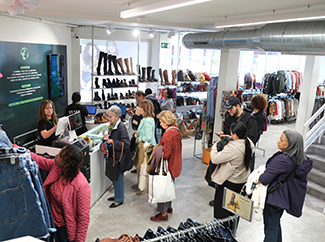
Second-hand stores have evolved tremendously in recent years, both in terms of inventory and appearance. They have transitioned from cluttered, unattractive spaces into spacious locations with diverse offerings and a mission to reach a broader audience.
By autonomous community, half of the second-hand fashion supply is concentrated in three regions: Catalonia (181 points of sale), Andalusia (139), and the Community of Madrid (126). These are followed by the Valencian Community (86) and the Basque Country (56).
RELATED NEWS
Spain has 800 second-hand fashion shops, half of them in the hands of social organisations