consent_cookie
Duración: 1 year
Stores the user's cookie consent state
28-01-2026
Humana consolidates its commitment to generating green jobs, especially since the end of the pandemic: our workforce has grown by 7.6% in 2025 compared to the previous year (794 employees compared to 738 in 2024), an even more notable increase over the last five years, during which time it has consolidated 244 direct jobs.
Humana closed in 2020 with a workforce of 550 people. Since then, we have created 224 direct jobs, reaching 794 employees at the end of 2025, an increase of 44.4%. In the last financial year, Humana's workforce grew by 7.6% compared to 2024, despite the closure of the Galicia branch.
‘Our organisation is proud to play an important role in generating green jobs. It shows that professional textile waste management allows us to create quality, stable green jobs, despite the difficulties in the sector and the disadvantage of organisations without a market reserve,’ explains Rafael Mas, the foundation's Director of Projects and External Relations.
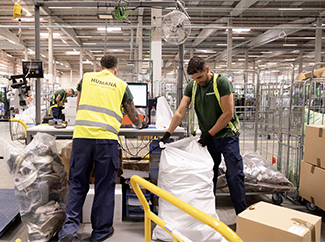
Humana's job creation is based mainly on two areas of activity: the sorting of collected textile waste (last September we opened our new plant in Leganés) and our network of shops.
57 shops in Spain
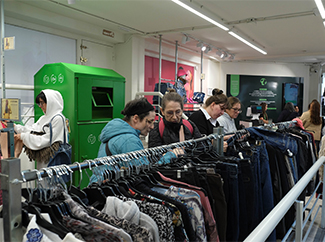
Humana is the leading operator of second-hand fashion shops in Spain in terms of customer numbers. In 2025, its 57 points of sale accounted for 7.6 million garments sold and 2.8 million buyers.
We closed 2025 with 57 stores, up from 52 the previous year (we opened six and closed one), and we are starting this year with an opening in sight: this Friday, 30 January, a new point of sale will open in Granada. It will be the second Humana second-hand clothing store in the city, the fourth in Andalusia and the 58th in Spain.
The funds generated by the network of shops enables social initiatives in Spain and development cooperation projects in southern countries to be promoted in collaboration with local partners, such as projects for training primary school teachers, sustainable agriculture, and the fight against HIV/AIDS and tuberculosis.
Clothing collection
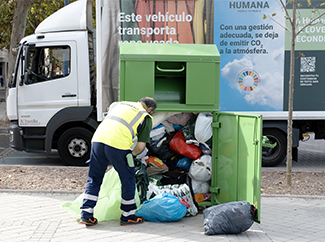
The selective collection of textile waste in containers managed by Humana enabled 20,381 tonnes to be recovered last year in Spain (equivalent to 82.5 million garments), representing an increase of 6.9% over the previous year (19,074 tonnes).
‘Selective collection has increased because citizens are more aware of the second life of used clothing and because there are more containers on public roads, given that this service has been mandatory in all municipalities since last year,’ says Rafael Mas.
‘However, the quality of the garments is lower than in previous years,’ he warns, ‘because the clothes that people buy are generally worse than before. So, yes, we collect more, but the quality has declined. That's where SCRAP must play a fundamental role; we managers must be supported in this process.’
RELATED NEWS
In 2024, Humana recovered more than 19,000 tons of used textiles